Process
Hiring without HR: a hiring process a founder can run
Most companies under a hundred people have no HR department. The founder, an operations lead or the manager who needs the help does the hiring between other work. This is a practical recruiting process for that situation: seven steps from defining the role to the offer, with notes on where software helps and where it does not.
weone team6 min read

Why write a process down
Without a process, hiring runs on whoever is least busy that week. Applications pile up in an inbox, the first decent candidate gets an offer because everyone is tired of interviewing, and the next hire starts from scratch.
A written process fixes that without adding bureaucracy. It does not need to be long. It needs to say what the role is, how you will judge people, who interviews and how fast you will answer. The steps below take a few hours to set up the first time and very little after that.
The hiring process, step by step
Seven steps. Each one ends with something written down, which is what lets you hand the next hire to someone else.
Define the role
Write down what this person will do in their first ninety days, the three to five things they must already be able to do, and what you will pay. If you cannot name the must-haves, you are not ready to post.
In weone: Add up to five must-have criteria to the job. They become the checklist the AI marks every applicant against.
Write the job post
Lead with the work and the pay, then the requirements, then the company. Cut anything a candidate cannot act on, and say plainly if the job needs a license, a fixed schedule or heavy lifting.
In weone: The AI drafts a description from the title and your notes, or tightens one you already have. You edit before it goes live.
Share it where your candidates are
Your own careers page, your network, your team’s network and the local places that fit the role. Referrals from current staff are often the best source a small company has.
In weone: Every published job gets a page and an application form on your weone subdomain, with a button to share it to LinkedIn. On Pro and Max, jobs are also listed on Google for Jobs.
Screen applications
Read for the must-haves first and nothing else. Reply to everyone, including the people you are not moving forward: a short, polite no protects your reputation in a small market.
In weone: Resumes are parsed and scored against the job, with a reason for each criterion. The score ranks; it never rejects anyone. You decide who moves on.
Interview
Use the same questions for every candidate in a round, and agree beforehand who asks what. Two or three conversations are enough for most roles, and a short paid work sample can replace one of them.
In weone: Send a self-scheduling link so the candidate picks a time from your availability. The Google Meet, Microsoft Teams or Zoom link is created from your connected account, and reminders go out on their own.
Decide
Have each interviewer write down a verdict before anyone discusses the candidate. Then compare against the must-haves from step one, not against the last person you met.
In weone: Each interviewer files a scorecard: a five-point rating from strong no to excellent, with notes. Hiring managers and interviewers join free.
Make the offer
Call first, then send the offer in writing: title, pay, start date and how long the offer stays open. Keep it short. Terms that need a lawyer need a lawyer, not a template.
In weone: Write the letter from a template or upload your own PDF, add the salary, start date and respond-by date, and send it from the candidate’s record. The candidate reads it and signs online, and the signed PDF is saved on their record.
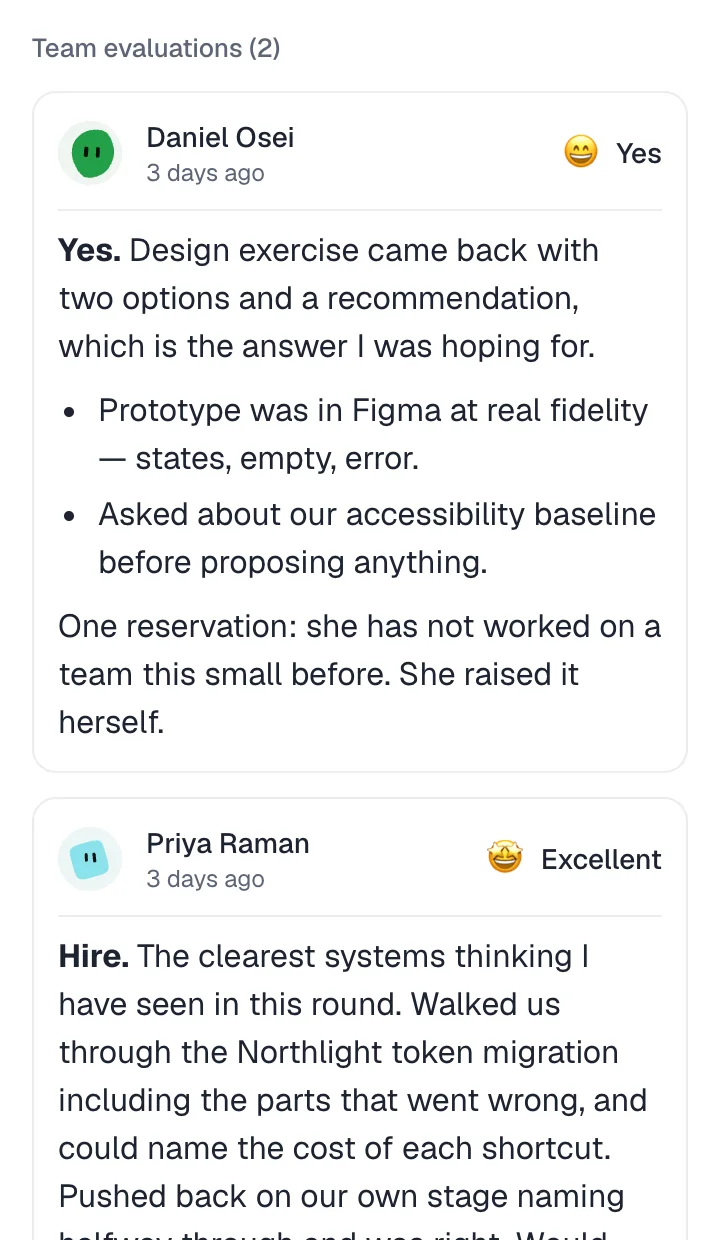
Evaluation · scorecards
Every interviewer’s rating and notes, on the candidate’s record.
What weone does not do
weone carries the hire past the signed offer into an employee record and onboarding. The paperwork the law asks of a US employer sits outside it. These are the official US sources for each part; for your state’s rules, check with your state labor department or an employment attorney.
Form I-9
Every US employer completes Form I-9 for each new hire to verify identity and work eligibility, within the deadlines USCIS sets. weone has no Form I-9 workflow.
USCIS: Form I-9E-Verify
An online check of I-9 information against federal records. Voluntary for most employers, required for some by state law or federal contract. weone has no E-Verify connection.
E-Verify.govEmployer Identification Number
You need an EIN from the IRS before you can run payroll. Applying directly with the IRS is free.
IRS: Get an EINForm W-4
New employees fill in a W-4 so you withhold the right amount of federal income tax. weone does not handle tax forms.
IRS: About Form W-4Payroll and employment taxes
Paying wages and depositing withholding is a payroll provider’s job, or yours with the IRS employer’s tax guide open. weone does not run payroll.
IRS: Publication 15 (Circular E)Background checks
If you run them, federal rules cover how you get consent and how you act on the results. weone does not run background checks.
EEOC: Background checks for employers
These links go to US government websites. Nothing on this page is legal or tax advice.